
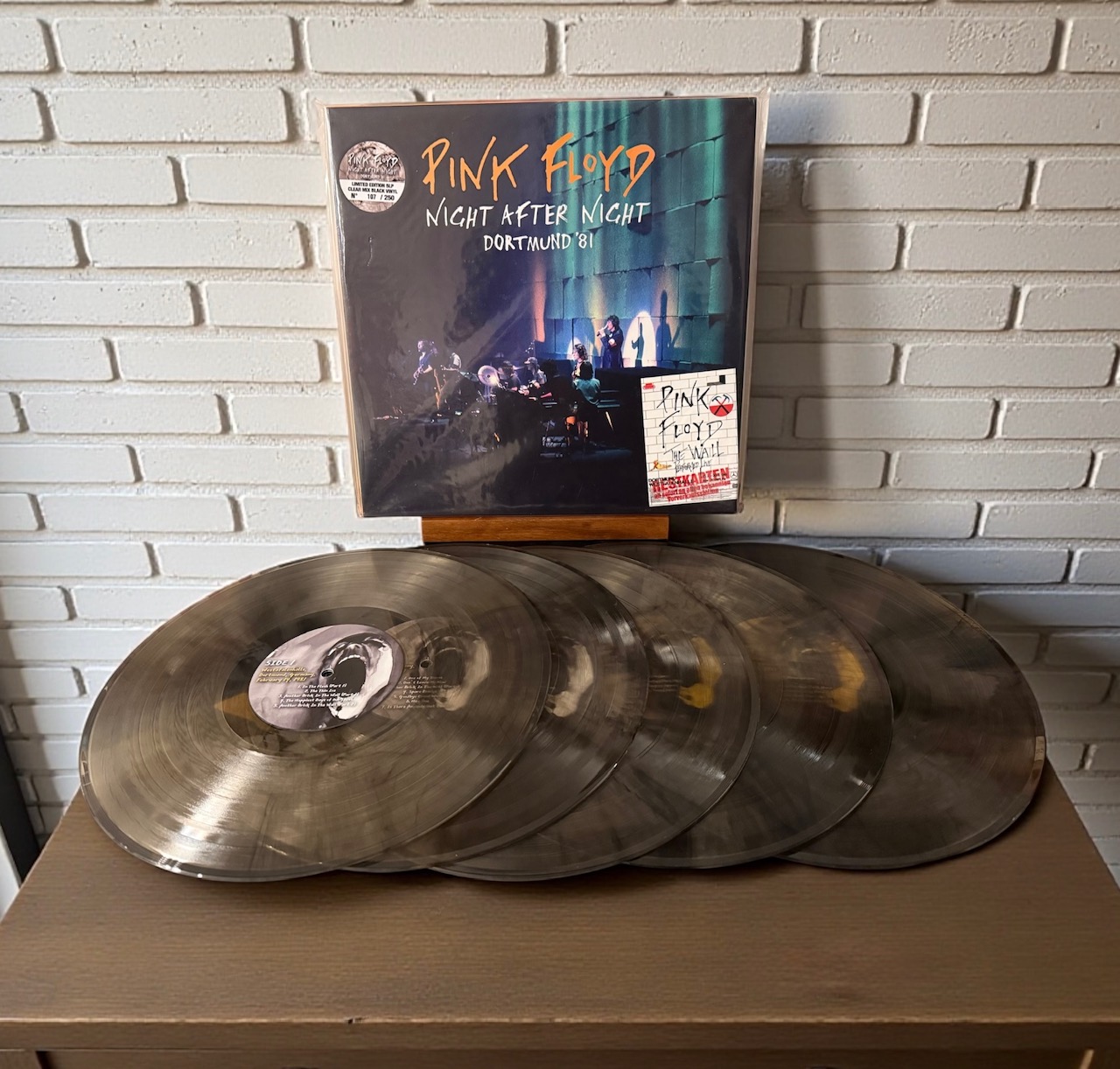
After my expensive reviews of Wish You Were Here over the last month or so, I have finally started to think about other Pink Floyd albums again. I have talked about several unofficial box sets for The Wall, and there are some really good ones out there. Most of them are by Casino Records, which is my all-time favorite unofficial label. Some releases say Casino and some say The Godfatherecords, but I believe both labels have the same company behind them. Night After Night is yet another top-quality Casino release with excellent audio quality, but it also has some unique aspects to it that other performances of The Wall don’t have.
First of all, Night After Night: Dortmund ’81 is a full box set. This is a gimmix style box, and the artwork and printing on the outside is crisp and clear. It’s available in two different colors, on either a clear/black mix or clear/yellow mix. Each color is limited to 250 numbered copies, which means there are only 500 total sets floating around out there. Each one comes housed in a re-sealable plastic sleeve with a numbered sticker, colored to indicate which set you got. It’s been a couple months since I acquired this one, but I have the clear/black set. I suppose I must have picked that color, even though I feel like I would have rather had the yellow.


As far as the box contents, everything is pretty standard for a Casino Records release. We have a four-page foldout booklet with some liner notes by Alex the Gnome, a miniature gig poster, and an individually numbered certificate that matches the number on the outside sticker. The 5 LPs come stored inside black poly-lined sleeves and have really nice labels. There are two complete shows contained in this set, and the labels are different colors for each of them.
The artwork on both labels is the same, but the first show has black and white coloring, while the second show has yellow. The third record in the set has a black/white label on the first side and a yellow label on the second side, indicating the show switch. I thought this was a simple but clever and effective way of telling the shows apart at a glance. All of my discs were totally flat, heavy, and free of defects. I cleaned them anyway on my ultrasonic and VPI before giving them a spin as I usually do.
The Setting
These two shows are from back-to-back nights, on 14 and 15 February 1981. They were part of a string of eight German shows that took place at the Westfalenhalle, Dortmund, Germany. Rather than moving the massive production around the country, they just kept it in the same place and allowed the people to come to them. This wasn’t unusual, since The Wall often stayed in the same place for extended periods due to the complications of moving the set pieces and band equipment around the world. What made it interesting was that these shows were in Germany.
As any Pink Floyd fan probably knows, Roger Waters is a political guy. You might agree with him, or you might not, but I feel like most of us can respect his passion and level of dedication. As far as lyrics and themes go, it’s a pretty well-known fact that The Wall is kind of the first Roger Waters solo album, which was of course followed by its not so well-received sequel, The Final Cut. The themes of these albums are not at all hidden and are out there for everyone to see. From a German Stuka crashing into the Wall at the end of the first song to a full blown Nazi-esque rally during “In The Flesh (Part 2)” and “Waiting For The Worms”, this concept album pulls no punches when it comes to discussing themes of war, racism and fascism. Needless to say, Germany in 1981 was an… interesting place to do this.
My first thought was that the show may have been censored to some degree, but I didn’t recall hearing anything of the sort over the years. It also doesn’t sound like something Roger Waters would allow to happen, but I couldn’t recall ever hearing these German tapes before in any format, let alone on vinyl, so I didn’t know for sure. Putting the first record on, I was surprised that I didn’t hear Gary Yudman (or any MC) making the typical pre-show announcements. The recording fades in with a bit of crowd noise, and then just goes into the music. The character doesn’t say anything questionable or offensive, so I wasn’t sure why they would take him out unless it was due to the language barrier. When I got to “In The Flesh (Part 2)” and he still wasn’t there, I assumed this must have been the case. As far as I can tell, audience reactions were normal, and nothing else was missing from the show.


Night 1 – Audience Recording – Westafalenhalle, Dortmund, Germany – 14th February, 1981
This show is obviously an audience recording. The audio quality fluctuates a little bit from time to time, but in general, it’s pretty clean. There is a bit of audible tape noise, and the audience noise is louder in some places than others. For the most part though, it gives you a feeling of really being there rather than being a distraction. As I mentioned in the beginning, there is no Gary Yudman character to make the pre-show announcements that we’re all used to hearing in English speaking countries. The band goes right into the show without announcements of any kind.
When the band gets to “Brick In The Wall (Part 1)”, the audience starts to clap pretty intently, but unfortunately for the musicians, they are a bit off time. Thankfully, this dissipates rather quickly but does become something of a recurring issue. “The Happiest Days Of Our Lives” and “Brick In The Wall (Part 2)” have some more clapping and enthusiasm. Gilmour’s solo is crystal clear, and he does an amazing extended version. Roger’s bass guitar in “Mother” is quite dominant, and the guitar solo is once again extended. There is a little bit of improv in there, but mostly it’s the same extended solo that we hear on Is There Anybody Out There? From the inception of The Wall up until Roger last performed it, English speaking audiences have always responded loudly during this song. In contrast, there is no audible audience reaction on this night when they are asked if they should “trust the government”.
“What Shall We Do Now” is always great to hear, and I wish it would have been possible to include it on the album. When I first discovered the official live version of the album when I was a child, this quickly became my favorite track, and it remains high up on the list till this very day. When we get to “One Of My Turns”, the volume increases quite a bit. I think that this is just how the band played it rather than a tape issue, but it’s very noticeable. Suddenly, the bit of tape hiss that’s been audible vanishes at the start of “Don’t Leave Me Now”. I’m not sure, but this could be an indication of a second source or a tape flip. Either way, the transition is professionally made and sounds fine.
I think that all of the live vinyl versions I have of The Wall have split up the tracks in a different way than the album version. Since this set has two shows over 5 LPs, I can understand that they wanted to conserve space. However, The Wall definitely loses something when the first LP doesn’t end with “Goodbye Cruel World”. In this case, Side C continues on into “Hey You” and “Is There Anybody Out There”. At this point, the weird rhythmic clapping starts up again until the audience realizes that it sounds awful and they finally stop. I have heard almost all of the bootleg versions of these shows that exist, and I’ve never heard anything quite like it.
“Comfortably Numb” is a great version as usual with a killer extended solo, but it probably won’t surprise Floyd fans in any way. The light tape noise returns during “The Show Must Go On” and is present for the rest of the performance. There is no MC for “In The Flesh (Part 2)”, and the introduction to “Run Like Hell” is dramatically shortened, probably again due to a language barrier. Instead of getting a bit confrontational with the audience, he instead says something like “leave our pig alone!” and ironically, “we have ways of making you clap!”. All of a sudden, the audience is magically resistant to clapping, but they quickly get the cue and join in happily at the one moment in the show where it’s acceptable.
“Waiting For The Worms” sounds a bit distant and quiet, but once we get to “Stop”, things get louder again. The only thing I can think is that there are multiple sources joined together as one to piece together the full show. “Outside The Wall” sees a final attempt at awkward clapping, and I have the feeling this almost broke the band. The rhythm of the audience is painfully out of time, and it must have been very difficult to keep on beat. Overall, this is still an excellent show and is a worthy addition to any Floyd collection. Even with the clapping.


Night 2 – Audience Recording – Westafalenhalle, Dortmund, Germany – 15th February, 1981
Once again, there is no introduction and the band gets straight into the music. Right away, we can tell that there is no tape noise and that this is going to be an excellent recording. It’s not quite soundboard quality, but it’s very close most of the time. “Brick In The Wall (Part 2)” has a solo that’s quite different from the previous night, and I like this version a bit better. “Mother” has the volume noticeably increase during the guitar solo, but it’s skillfully done and I think it must have been intentional. Thankfully there is no weird clapping here and although this solo is pretty much always identical, I would say this is still my favorite between the two.
Someone does try to start the clap during “Goodbye Cruel World”, which might be the most inappropriate moment ever in a rock concert to do something like that. Mercifully, this dies out very quickly, and you can almost feel the rest of the audience glaring at the guy who tried to start it. “Hey You” starts very quickly afterwards and feels kind of strange with such a fast transition. There was a 20-minute intermission at the actual show, of course, and on the official live version, you still have to change the CD to go on to the second part of the album. This helps retain some of that feeling of time lapse which is missing here with the songs broken up for space rather than dramatic effect.
For some reason, the band fades in to “Is There Anybody Out There” before “Hey You” is finished. This results in some lyrics still being delivered right before the start of the acoustic guitar solo. “Comfortably Numb” is still great, of course, but I think I preferred the first night’s solo over this one. “Run Like Hell” is pretty much the same as the first night, but this time Roger asks, “Do you like our pig?” The rest of the performance is pretty uneventful until we get to “Outside The Wall”. For some reason, the song is cut short and there are no lyrics. Perhaps there was some kind of technical glitch, or maybe the band didn’t want to risk having to deal with the potential of more bizarre clapping during an acoustic piece.
Conclusion
Overall, this is not my favorite box set for The Wall, but it is a good one. The second concert is the superior one audio-wise and probably even performance-wise. There is less awkward and distracting clapping during the second show, and the audio quality is almost like a soundboard. That doesn’t mean the recording of the first show is bad, though. I think most collectors will enjoy that one as well. Show #1 (14 February) is about 7/10 on audio quality, while I would place Show #2 (15 February) around 8.5/10. Pressing and packaging for this set is easily 10/10, as it’s well put together and very high quality with no defects or notable surface noise.
The big question though, is who is this set for? I would say that Night After Night is best for collectors who already have everything else and are looking to get as many versions of The Wall as possible into their collections. If you just want some fantastic live Wall shows on vinyl, then I would consider checking out something like California 1980: First And Last Bricks or even the mega-set London 1981: Goodbye All You People. Think of Night After Night as an expansion pack, and these other boxes as the main foundation. I can’t promise you that either one will be easy to find, but if you are interested in Pink Floyd history like I am, it will be worth the effort.

Happy digging!